


I have two weeks left in a six-month drinking break, which led my eyes straight to a collab between Brooklyn restaurant The Four Horsemen and Copenhagen N/A blendery MURI on the drink list at Rodeo. This was my first real dinner in Norway, kicking off a nearly month-long stay in Oslo. The waiter’s eyes lit up.
“Oh, you know The Four Horsemen? They’re our inspiration.”
The chef-owners of this months-old spot had a life-changing meal at Nick Curtola’s perfect little Williamsburg wine bar, and decided to bring their own version back home.
“Does it seem similar?”
A little, yeah. More spacious, certainly. Room for curved wood around every corner. Scanning the tables, it could be Oslo’s answer to where hot people eat well. You see the familiar beats across the menu. A bold, recognizable dish or protein — hamachi, beef tartare, ricotta dumplings — followed by a clever little twist of accompaniments, like lovage, roe, ponzu gelée, pine nut puree. The Wildair- and Four Horsemen-ification of contemporary restaurants has reached its mature phase, both domestically and internationally. Twenty-five years removed from the original Paris bistronomy movement, it’s easy to see and hear identifiers from these two second-wave restaurants across menus and dining rooms. Less a trend, more a default proving ground for the young, ambitious and unconstricted.
I witnessed this in Paris in January at L’Arpaon up in the 18th, a stunning meal that began with a towering bowl of herb-butter clams. They looked familiar, yet tasted unlike any version I’d had before. L’Arpaon banged out vaguely North African flirtations with this now well-known genre. The couple next to me each ordered their own serving of a heavy, buttery, indulgent black pepper paccheri, cleaning their bowls. I don’t think they had sex. The restaurant closed for good a few weeks later.
There’s an inherent appeal and tension inside these children of the very best of the 2015 New York City wine-and-small-plates boom, rooted in how difficult it is to reach and then sustain such impeccable heights. You’re setting yourself up for the trickiest of tightropes. Follow hyper-seasonality. Play off your roots and inspirations. Reach for the familiar and then spin it around your fingers. Comfort and delight and surprise. Make your neighbors feel like it’s their spot but signal to visitors you’re a destination. Charm food media, influencers and tastemakers. Desperately hold onto cooks who are capable of executing such a feat day after day. Strive for grand ambition and then focus on step-by-step precision without ever slipping. Otherwise, it’s just a celery salad, rather than the celery salad. It’s mostly a feat attempted by kids who don’t know any better, before the safety of martinis and fries and pasta come calling.
This kind of teetering is evident on Eldridge over at Bistrot Ha, captured in a recent two-star review from Ligaya Mishan in the Times:
The menu keeps changing, and not just to accommodate what’s in season. [Owners Sadie Mae Burns and Anthony Ha] are stubborn and almost dogmatic in their insistence on the pleasures of improvisation and spontaneity. You sense an antsiness in the kitchen.
And yet: Isn’t boredom — making the same dish over and over — the path to mastery, or at least consistency? Each time I set foot in Bistrot Ha, I never knew quite what to expect. I was by turns charmed, puzzled, disheartened, then charmed again, and slightly wistful for all it could be and almost is.
Burns re-posted the review, responding, in part, with:
If cooking is about exercising the creative, personal and impulsive bits that exist between the two of us, then restaurant ownership is about giving all of these elements their opportunity to shine and about sharing this with our incredible staff. We have a constant desire to perfect, change, innovate, tweak and embrace all sides of what cooking and hosting can be.
We have always combined our personal with what we do at Ha’s (in many ways they are one and the same) and along with our guests who’ve come along for the ride, I think it’s part of what makes the spaces feel special, and above all: alive.
Amen. I like consistency. Sometimes it’s exactly what I need. Knowing just how the brouillade at Frenchette sets or instinctively repeating the same order at Cervo’s. But while traveling, I can’t avoid reaching for the potential in combustible palaces like Ha’s. When it hits, I want the only-here kind of magic that happens in these environments.
We’ll get into the NYT Food star-inflation conversation permeating my off-the-record DMs another time. Eddie Huang wrote about it well here. But for now I’ve got some thoughts on travel, recommendations, and AI slop to get into …
Technology, travel and slop
I ended up at Rodeo through the same methods I always use when traveling somewhere for the first time, which looks like:
Make a list for the city on Postcard, a (not-sponsored) improvement to incomprehensible Google Maps compilations or Notes app lists.
Get a general lay of the land by hitting up a few trusted, well-traveled friends and supplementing that with some raw Google searches. Everything from a Vogue list to a Michelin Guide to a random Substack newsletter with 200 subscribers is on the table.
Start saving places to the Postcard list that pass the digital vibe check, and build it out with related spots that do the same. Instagram’s suggested accounts feature is good for this. Balance getting enough information without tipping over into such deep review readings and tagged IG scrolling to have the experience before you even arrive.
In general, I’m looking for any post-pandemic restaurant or bar that has a chance to capture that Ha’s energy, established classics (even if it’s just for the room), excuses to hit multiple neighborhoods, some art, a tiny bit of nature, fancy grocery stores, a movie theater, shopping and a place to do yoga/pilates with one of those absurd first-month discounts.
From there, I’ll book a few dinners if they look truly can’t miss. Otherwise, I’ve got this map-based list to reference while bopping around. I don’t like itineraries. When I land, I’ll go for a long run to get my bearings.
Visiting a new place is one of the quickest ways to encounter slop, a problem that’s always existed but feels exacerbated due to a combination of short-form video feeds prioritizing time-spent metrics, a decline in well-funded and well-gatekept travel journalism, and AI-generated content powered by unlimited volume with minimal friction.
This platform has new tools for detecting specific kinds of AI writing slop through a partnership with Pangram. I share similar feelings about it to what Alex Heath wrote here: “I’m all for attempts to disclose AI’s role in the process as people get used to this new world … but I predict it will be a moment in time we’ll look back on, not something that endures. AI is just a tool. What matters is how you use it.”
Slop proliferates when tools are used poorly, whether that tool is Cursor or a big dumb brain. No one has defined slop better than my former boss Dan Shipper, who wrote, “Because everyone has access to the same models, and the models are all based on yesterday’s competence, by default the models end up creating work that ranges from ‘a decent start’ to ‘it’s just plain slop.’ Slop is not any one particular mistake. It is not the use of em dashes, or a certain sentence rhythm, or purple accents on a landing page. Slop is visible sameness, repeated ad nauseam. It is what gets produced by default when humans in many different circumstances use the same tool, trained on the same corpus, without thinking too hard. It is what happens when everyone has access to an expert who has the same default tendencies.”
Slop is easy to spot because it’s boring. I pay for writers who give me some mix of three things: information I don’t already have, perspective I haven’t considered, and entertainment while delivering the first two items. Look at J Lee just yesterday on secret Keens chicken tenders as an example. Or what Louis Cheslaw is doing at Wardrobe. Or every Kaitlin Phillips missive in Gift Guide. You can’t read their work and perceive any kind of visible sameness built on cheap competence, AI-assisted or not.
The intention behind these binary, AI-or-not labels is valid, but I’d prefer to dig in a hair deeper, identify if something is boring, and then recognize that I can just mute people. Instagram used to serve me videos from one specific food creator who goes to every predictable New York restaurant, tries the most famous dishes, regurgitates popular reviews and wears bad golf polos. I’d always watch, in judgment, so then I’d see even more, despite not following. Is this creator using AI? I don’t think so. Is it slop? Yes. So I muted, which has been lovely. You aren’t in complete control of your experience online, but you often have more influence than platforms would prefer for you to realize. Substack, thankfully, keeps its pure Following feed sticky if you switch over to it from the discovery-oriented For You default.
If you want a look into the future of slop-filled travel, you can see it in posts like this one on X:
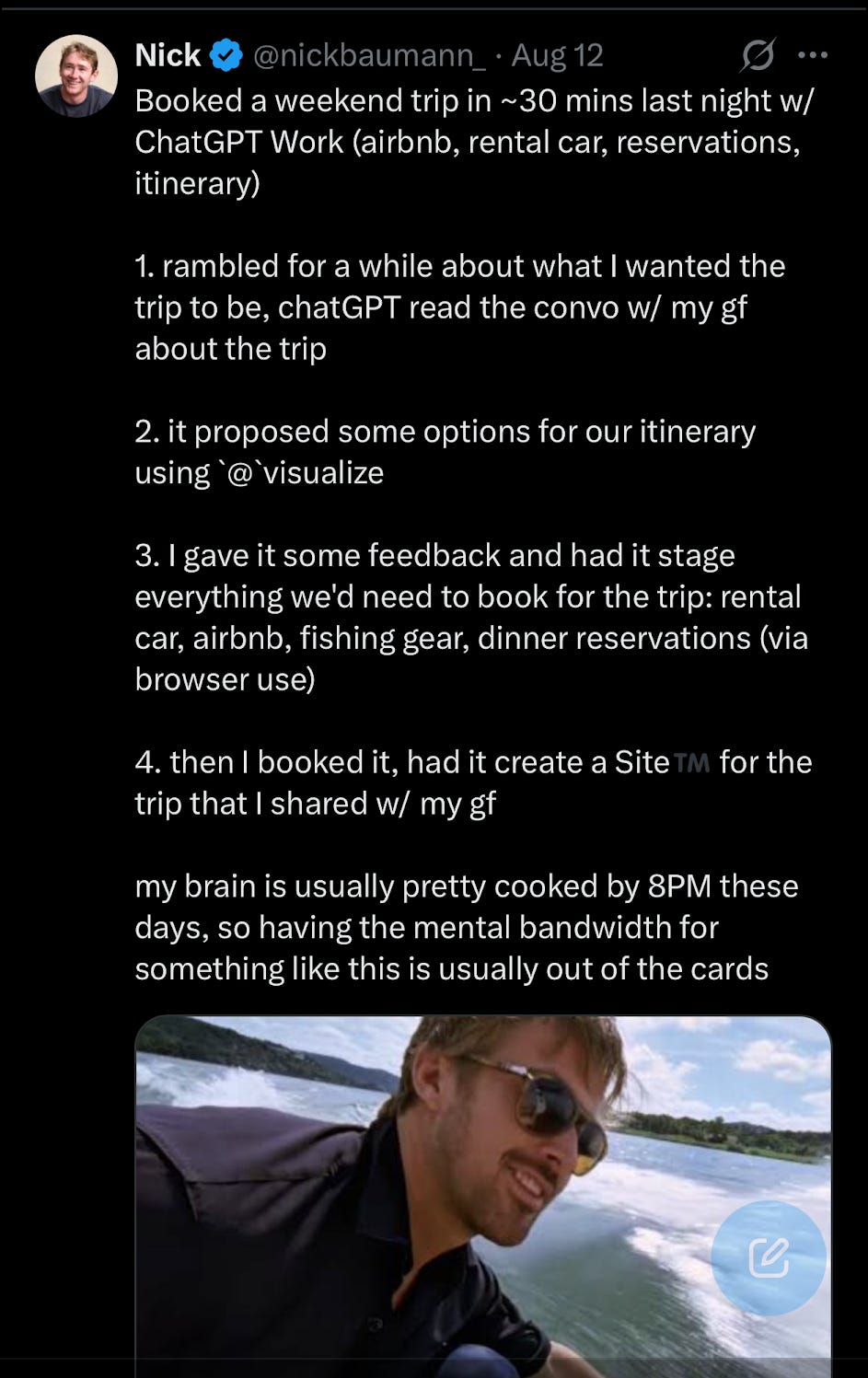
The last point certainly resonates. I recently had Codex handle every aspect of listing my Los Angeles home on Airbnb, a task for which I simply didn’t have the time, patience or expertise. It was quickly booked while, instead, I went to Silver Springs. AI is amazing for these computer errands. But the best kind of travel is personal. Turning over your vacations to a cheap competence machine leads to a beigening that should incite Agnes Callard to produce a follow up to her excellent Case Against Travel.
Here’s a practical example: A good friend is about to visit Maine for the first time and asked for my recs. I delivered a shortlist specifically tailored to what I know she likes, and she sent back a Claude-Code-generated itinerary produced by a prompt that directed the model to combine my recs with everything Claude knows about her. One of the first tips was to book a dinner at Fore Street, a fine but forgettable restaurant she’d find dull and stale. It’s also the most recommended restaurant in Portland, so despite the personalized prompt, the model can’t help but nudge a user there. And then nudge every other user there, for the same experience. This is coming for where people eat dinner, as Emily Sundberg wrote here in Feed Me, and basically everything else.
Travel, like New Year’s Eve or Las Vegas, is one of the great tests of your ability to know what you like and make it happen. Some friction there is good. Maybe necessary. I’m not above using AI or other kinds of technology to make my life easier. It’s what I’ve dedicated a lot of my career to. I had Codex search Norwegian businesses Girl In Red follows on IG that I should consider checking out so I wouldn’t have to open 200 tabs, and I’d gladly increase my newsletter subscription price for a model to quickly query the Kaitlin Phillips, laura reilly and Emily Wilson archives I search manually before a trip.
I’m back on my couch in Sagene after spending a couple hours hunched over the snack bar at Credo. A local man dining solo — “All meals are half-price because my wife is out of town” — gifted me his butter. A young Italian cook explained to me how their gorgeous, old Swedish oven works. I’m still spinning over his cream cheese, strawberry and bay leaf dessert. And after I hit send, I’m going to hit a bar and dance to a Joachim Trier DJ set. I know what I like, and I’m open to liking more than that. It’s a good way to travel.
Amazing, I was nodding along from beginning to end
"my former boss Dan Shipper,"? You left Every?