


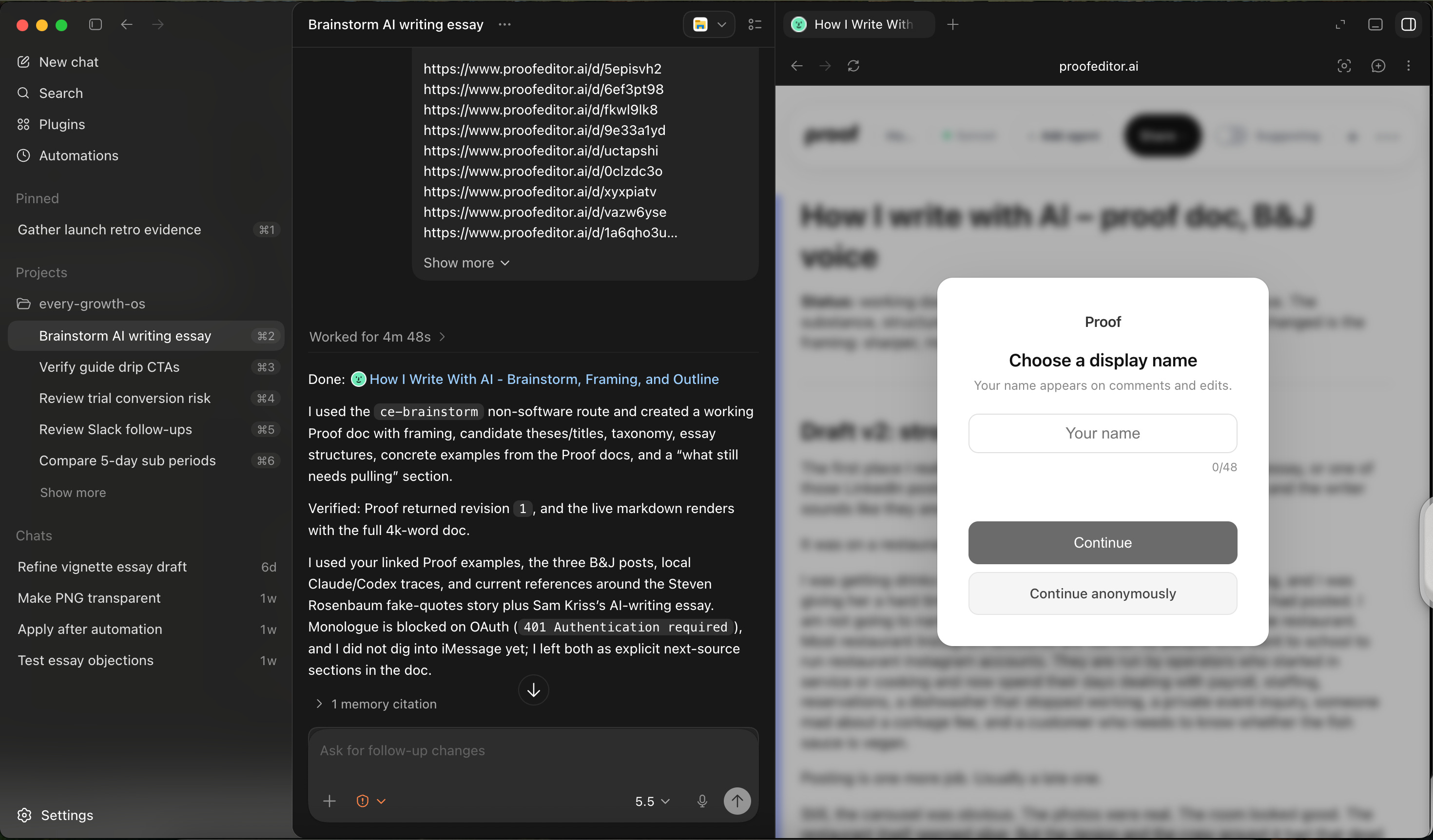
I got drinks the other week with a friend who does restaurant consulting, needling her about an Instagram carousel one of her clients had posted. Overlaying real photos of the space and the food were combos of graphics and text clearly generated via a basic use of Claude Design — drop in some photos, summarize the general message and medium in a chat, post what resurfaces, and move on to the next task.
The post did pretty well. Lots of likes, about 90% positive sentiment in the comments, and then a few stray callouts like, “Rooting for y’all but holy hell look at this AI slop.”
Small restaurants are exactly where we should expect to see even more AI writing in the form of marketing copy deemed slop, a term that has already been used on X 21% more in 2026 than in all of 2025, according to a quick API query.
It’s worth defining slop, so I’ll pull a quote from my boss, Dan Shipper, in his recent After Automation report:
Because everyone has access to the same models, and the models are all based on yesterday’s competence, by default the models end up creating work that ranges from “a decent start” to “it’s just plain slop.”
Slop is not any one particular mistake. It is not the use of em dashes, or a certain sentence rhythm, or purple accents on a landing page. Slop is visible sameness, repeated ad nauseam.
It is what gets produced by default when humans in many different circumstances use the same tool, trained on the same corpus, without thinking too hard. It is what happens when everyone has access to an expert who has the same default tendencies.
There’s little point in judging the restaurant behind that IG carousel, one where a GM with no other marketing support is doing everything possible to drive more sales. That’s how this happens. You’ve got an impossibly long to-do list, limited resources, immense pressure, and access to a tool that can quickly knock out tasks that, yes, produce artifacts with visible sameness, but are also better than what a front-of-house expert could construct themselves given several dedicated hours.
We’re on the precipice of an AI writing reckoning as these frontier models become more pervasive. Sam Kriss made the compelling case for murder. Emily Sundberg and Kyle Chayka dive into the taste and AI discourse extremely well. No one covers this space better than my former colleague Jasmine Sun, who shared this the other day:
I live these questions daily inside of Every, a frontier AI lab for the future of work. We’re a small company mostly made up of writers and creatives pushing these models to the limits. We use AI in our writing all the time, just like I use it for this blog. It undeniably has made me more productive, clearer-headed, strengthened my insight and curiosity, and improved the final output of what you’re consuming as a subscriber. I have specific, refined workflows depending on the type of writing I’m doing, just like I have hard boundaries for what I am and am not comfortable turning over to the machines.
After a friendly nudge from Alex Heath, lemme show you what that actually looks like in practice across internal company documents, marketing copy and the kind of creative, heartfelt, argument-driven writing that’s truly at the crux of this debate.
Strategy, planning and boldly sharing agent-written docs
I was at an a16z retreat the other week and led a workshop on using AI agents in the writing process. One of the things I walked through: how different kinds of writing carry varying stakes and quality thresholds.
I’ve worked in growth, GTM and partnerships for a while. The job involves a lot of documentation in the form of strategy plans, retros, data analysis, and cross-functional comms. Until about a year and a half ago, I wrote most of those docs from scratch, over and over. Here’s the process now:
I needed to revamp my team’s Q2 plan for a final-month sprint, documenting it so that the priorities and goals were clear inside our group and across the company. I also needed that plan to be informed by the larger company goals, the upcoming launch calendar and real metrics. This happens constantly among knowledge workers. It’s useful. And it’s also a silly thing to sit down and write from scratch.
I start by going to an ongoing thread for this kind of work in OpenAI’s Codex app, which is connected to all of the tools I use for work. Then I start a speech-to-text brain dump session with Monologue, offering a rambling breakdown of the problem, the outcome I want, and the open questions I need a fleet of agents to help me sort through. My colleague Kieran Klaassen calls this the AI sandwich. AI work is done best when humans are the bread in the sandwich, framing the issue, judging the results and then deciding where to go next.
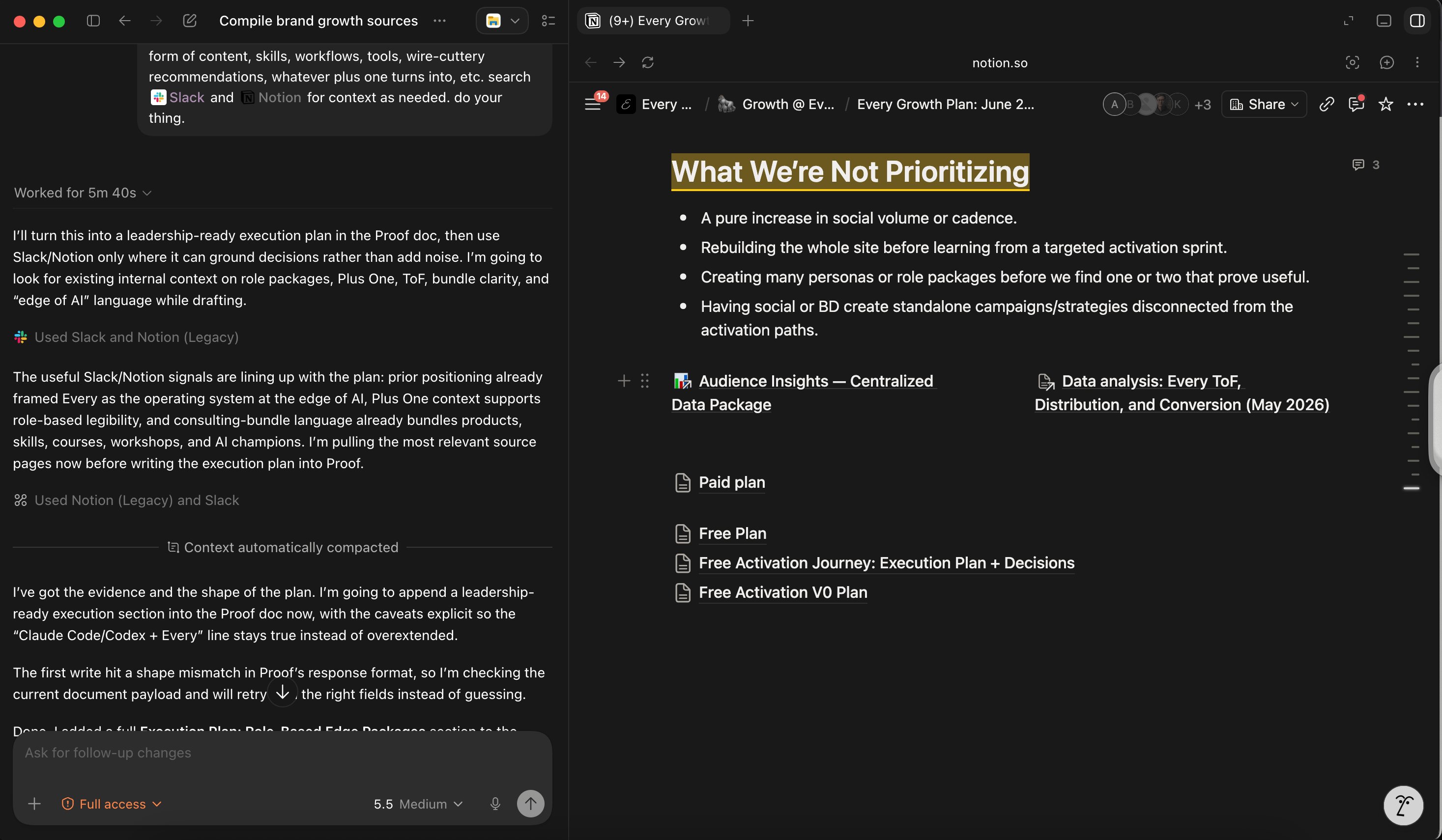
Through trial and error, my workspace is streamlined enough that Codex generally knows where to look to tackle the meaty tasks inside of the sandwich. Notion for meeting notes, PostHog dashboards for metrics, Slack channels for relevant discussions. The goal here is not for GPT-5.5 to come up with the Q2 growth strategy. It’s to synthesize the discussions we’ve already had across multiple surfaces, fork it into a new plan based on my suggested framing, and test that plan against real data.
The Notion strategy doc I get ~10 minutes later is usually about 70-80% of the way to being shareable, fitting into a pre-set template. I do a line-by-line review while looking at the doc via Codex’s in-app browser, so I can quickly ask an agent questions or work through revisions.
When I then go to share it internally, I’m transparent both about the fact that the doc was written with AI and that I stand by each claim. As Lenny Rachitsky said in an interview with Dan, most people are really bad at writing these kinds of documents. The bar is low. When directed well, GPT-5.5 or Opus 4.8 is actually just producing a better result much more quickly while depleting less of my energy. Which means I have more energy for higher-leverage work, or to go outside and touch grass.
An increasingly common occurrence across contemporary workplaces is seeing a colleague get asked a question about a point in one of these AI-generated docs, then realizing they’ve never seen that sentence before. This embarrassing exposure isn’t an AI problem. It’s just process, effort and critical thinking, things we can and should continue to value in any kind of writing.
Brand-approved marketing copy and assets
As more slop hits our feeds in the form of marketing copy and content, a quick way to earn praise and engagement is to loudly announce where you aren’t using AI:


Rachel Karten has covered this well, especially the demoralizing effects of top-down AI psychosis on marketing teams. When I read this reporting or see those Claude-created restaurant IG carousels, I see pressure and confusion turning the helpful structure of the AI sandwich into a crumbling tartine.
Let me tiptoe off the ledge and suggest another approach, because the same principles that lead to effective internal strategy docs can apply externally.
When people recoil at marketing slop, what they’re really saying is: I’ve seen this before. This isn’t moving or specific. This isn’t attached to a real point of view. There’s no expertise or differentiation in the form of human creativity. But what about when you already have that differentiated, expert work, and you need to package and promote it across surfaces through writing?
The clearest example is happening in podcasting. Once you’ve recorded an episode, AI can look at the transcript of that original, thought-provoking, human conversation and come up with display copy for YouTube and promotional posts for LinkedIn and Substack. Without much framing, the writing is fairly flat, even when pointed at a real transcript. Most podcast software now features these kinds of tools. I wouldn’t recommend using them in such a plug-and-play way.
I rely on a combination of Codex and Spiral — like Monologue, another Every product, in full disclosure — to solve for this. Spiral lets you empower agents with detailed writing styles trained on approved work, and combined with Codex or Claude Code it can weight past post performance to inform the AI-produced marketing copy. You get an okay enough YouTube description for your podcast by dropping the transcript into Claude. You get a much better one by running it through a brand-approved writing style via Spiral. Then you can have Claude Code look at your YouTube analytics and borrow from the formats that are already working. Is that slop, or is that marketing leverage designed to enhance algorithmic performance and reach, a shared goal among many creators?
We’re past the early stages of adoption for many of these AI tools in writing and marketing. But learning how to wield them is still fairly nascent. Thus, slop. Consider the effects on dining out decisions. Am I less likely to go to a restaurant that uses Claude Design poorly vs. one that set up a brand-friendly harness? Would I prefer that the owner-operators hired a social media consultant? Or devoted more time to being original? Is a lack of rigor in the marketing review process a sign that less care happens inside of the space?
I don’t know. I can’t imagine opening a restaurant and turning over my dining room playlist to a consultant. As someone who values vibes, experience and hospitality so highly, a personal touch matters to me. But that niche industry has existed for years, bending the acoustic experience to a more pervasive sameness. Sound familiar?
AI as researcher, partner and editor in creative writing
Sam Kriss is likely less committed to inciting violence over AI writing in internal strategy docs and YouTube descriptions. That is writing as utility. The writing that flourishes on this platform, the essays and arguments and reported narratives that drive subscriptions, the words that come from deeply felt compulsion and rewire your brain — that’s something else. Something much more important. As a former longform editor, it’s a thing I’ve spent a lot of my career working on. And, perhaps controversially, it’s also a thing I’ve found AI quite useful for.
So let me walk through how I write essays like this one with a mix of Monologue, Proof, Codex, and the usual, hours-long agony of figuring out what I actually want to say and how I want to say it.
My writing is at its worst when I don’t have the goods. When I’m sitting on a disparate, disconnected series of takes and observations that lack scene or structure or real insight. Over the past year, I’ve found a better way to give myself the confidence that I do have the goods, and then turn that into writing I stand behind.
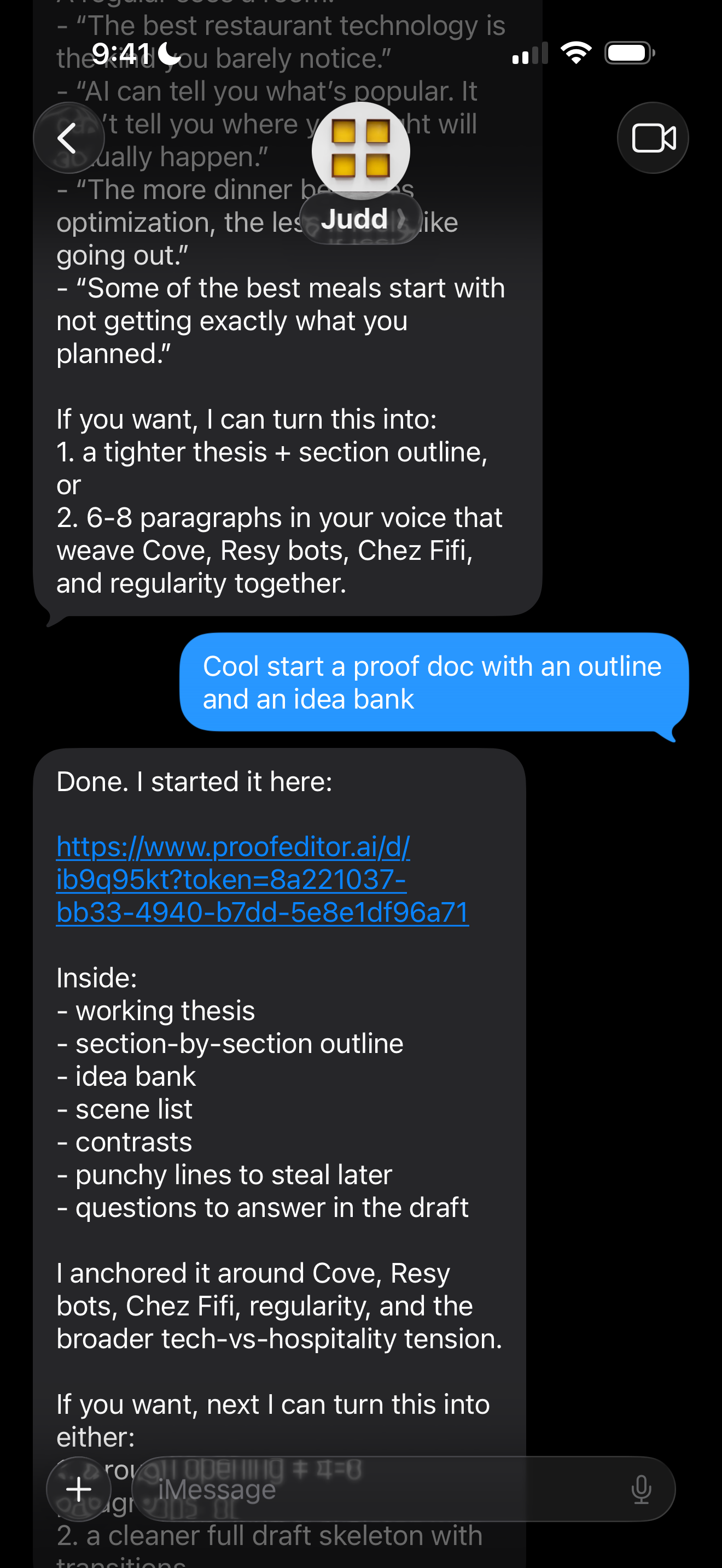
This starts as a running series of text messages between me and an OpenClaw agent. I get my best ideas during long runs, lazy drives or heated conversation. Before I know what a piece is going to be, I’ll text this agent ideas in the same way that many writers might write in a notebook or brain dump into a Google Doc. Sometimes I’m actually writing those text messages. Sometimes I’m using Monologue for speech-to-text.
Those ideas get organized in Proof, an open-source document editor for human-agent collaboration. The agent runs on a writing style for this blog through Spiral, takes my ideas from these text messages, cleans them up a bit, and organizes them into an idea bank. Through a back-and-forth poking at what feels interesting or wrong or underdeveloped, I get a clearer shape of the high-level idea.
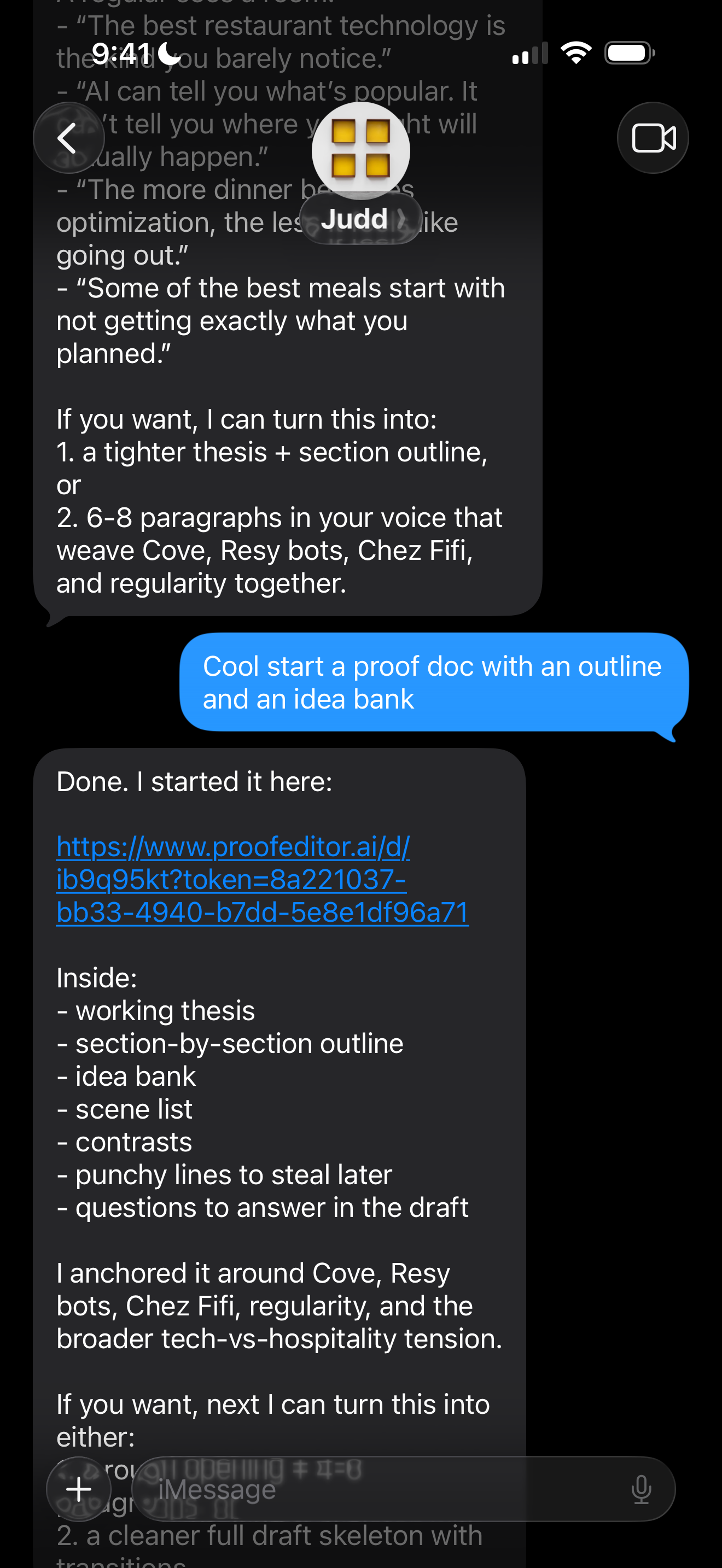
When prompted, the agent can pull past pieces I’ve written or scenes I’ve left on the cutting room floor. It can help with research. It can spot contradictions. It can act as both writing assistant and editor. And when the structure starts to make sense to me, I’ll tell the agent the outline I want and which details from the idea bank belong in each section.
Now, when I actually sit down to write, I have something to reference that inspires the confidence to do it well. I start with a blank page in one window and the notes in another. Because so much of the notes come from direct texts I sent or words I spoke into my phone, I’ll sometimes grab that text, move it into the main doc, and tweak after close review. If I hit a wall, I’ll Monologue a paragraph to help me break through. I typically write from beginning to end in one sitting, not moving on from a sentence until it feels perfect.
Then I read, and I edit, and I read, and I edit. I ask an agent inside Codex for copy edits, for places where the argument is weak, for ideas I said I wanted to hit but didn’t actually weave in.
This entire process falls apart if I listen too closely to the model’s advice. A good flow relies on my own experience and expertise to know what to consider and what to ignore.
Sometimes my writing is very good, and sometimes you all let me know when it’s not. The degree to which technology touched the process has little to do with that variance in outcome. Instead, it comes down to the same things that have always informed great writing: Have I done enough living out in the world to have something interesting to say? Do I have a compelling way to say it? And have I gone through the painful process of sharpening the words on this page to the point that it’s ready to hit publish and send to you?