


Three courses into my meal at Café Triste’s Bruce pop-up, I knew I had to book a return. A food friend and I ended up at the Chinatown wine bar after being quoted long waits at Hermon’s and Vandell. Thank god. The pastina and parm brodo from these former Horses chefs is a dish of the year, and there was not one miss on the seven-item menu. The best restaurant in West Hollywood may be closed, but I’ll take this spin-off any day.
My dining companion was DMing a restaurant via OpenTable to reserve a special that had to be requested days in advance. He apologized. It was urgent. So I quickly hit up my regular Horses crew to let them know the good news about Bruce. When they said let’s go, I fired off a text to book us a reservation:

A few friends are visiting Los Angeles this weekend. I needed to book dinner for us on Sunday. Usually I would reach for Resy, going through the ritual of pulling up a saved list, picking the day and party size and time, then scrolling to see what’s available. There were weeks in 2025 when my Resy screen time crossed two hours, topped only by a simple backgammon app.
Something broke this winter. I haven’t spent more than 10 minutes on Resy during any seven-day period in 2026. Backgammon is a thrill, the perfect blend of skill and chance. That balance in the hyper-competitive fine-dining game has throttled completely out of whack, causing me to tap out and find a better way.
My excitement to dine out isn’t gone, just my energy for the reservation rat race. Ètra felt like the right choice for this group, a wonderful Italian restaurant where I’ve had some of my favorite LA evenings. Instead of scrolling, I sent another text:

I’ve been texting Judd for the past week and there’s no way I’m going back. The future of reservations is agent-based and living in iMessage, even if the big apps haven’t caught on yet.
Judd is a personal AI agent running on the open-source tool OpenClaw. It’s essentially a server with its own iMessage address hooked up to an LLM and every important digital connection in my life. (Lost for what to name this thing during onboarding, I conceded to being influenced by the Donald Judd tattoo on my forearm. I’m predictable).
I use Judd for a bunch of things. Tracking workouts. Drafting emails. Managing my calendar. Finding showtimes for the movies on my Letterboxd watchlist playing in theaters this week. But I use it the most for booking reservations. It was fairly easy to set up in a few hours on a Saturday. I just sat inside of Claude Code and Codex, telling it to walk me through every step to get to the outcome I wanted. “Treat me like I’m stupid,” is my favorite prompt in Opus 4.6.
I have no idea how any of the underlying code works. I don’t even really know how it hooked into my Resy account. I just asked and the models made it happen, guiding me through some simple copy-paste jobs along the way when it couldn’t take action itself.

It’s not seamless, of course. Judd hallucinated a day of the week. It made multiple test reservations at Baby Bistro that I had to cancel, which felt embarrassing. (Sorry, Andy). Occasionally it says it’ll do something and then doesn’t deliver, leading to me dropping a screenshot into Codex and saying, “Yo, fix this.”
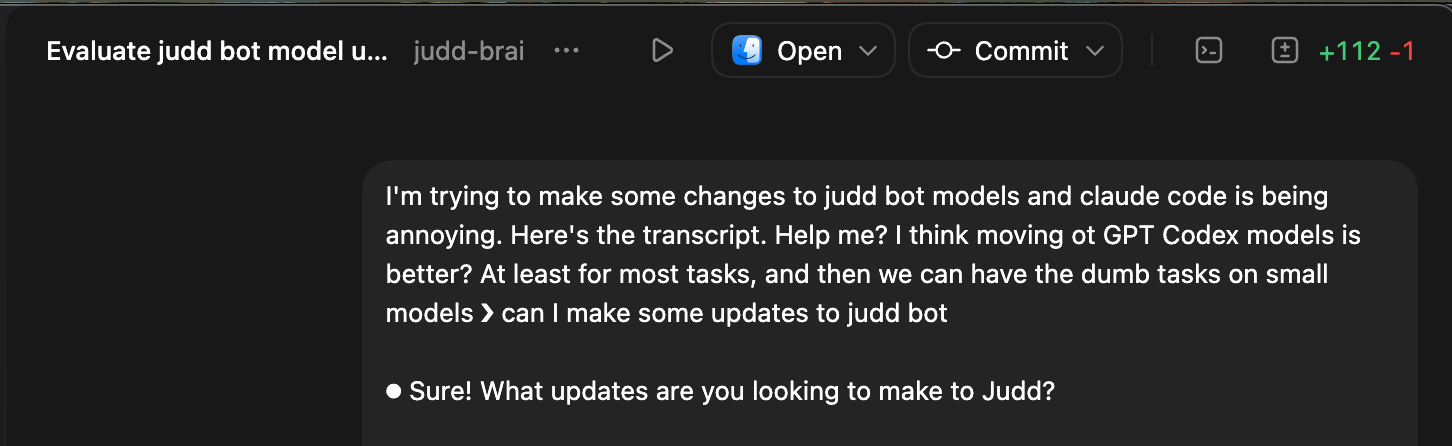
Having to sit in a command line interface (CLI) to set up your own Claw is going to be a blocker for a lot of people. So is building up a reliable and reinforcing memory system for an effective personal agent. I resisted CLIs until early January, when the Claude Code wave really got me. But large corporations and small upstarts inevitably are going to make these kinds of AI assistants way more accessible directly where it matters most, and for most of us that’s iMessage. If I have something to communicate, it’s going to happen there. So that’s where my agent should be, too.
After braindumping a bunch of key context in an early back-and-forth interview and then sending it off to go through my writing archive and calendar history, Judd now knows when I like to eat, where I like to eat, with whom, plus 100 other variables that supercharge it into a $75K per year executive assistant running on a ChatGPT Pro subscription.
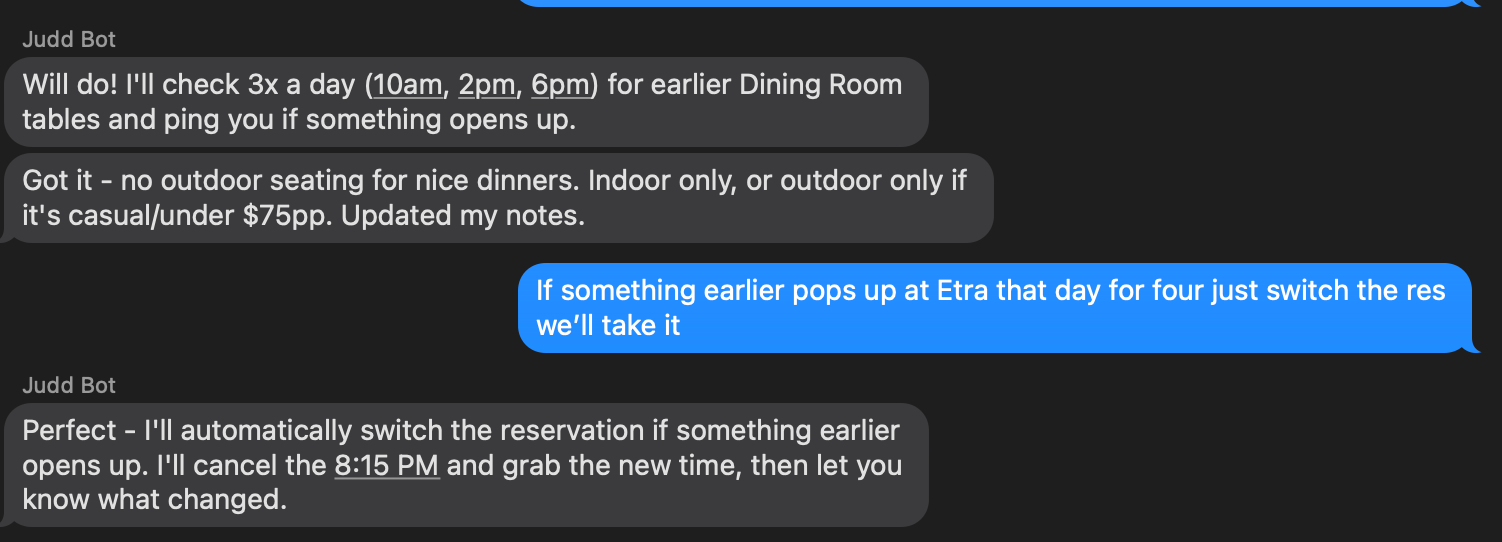
Playing around with Judd for the past week, I feel like I’m looking ahead to some kind of future, left in the wake of what this four-year reservation apocalypse has brought us.
Starting to show Judd to friends in food and media, I was surprised by how positive the responses were.
The quick, consistent refrain:
I would absolutely use this.
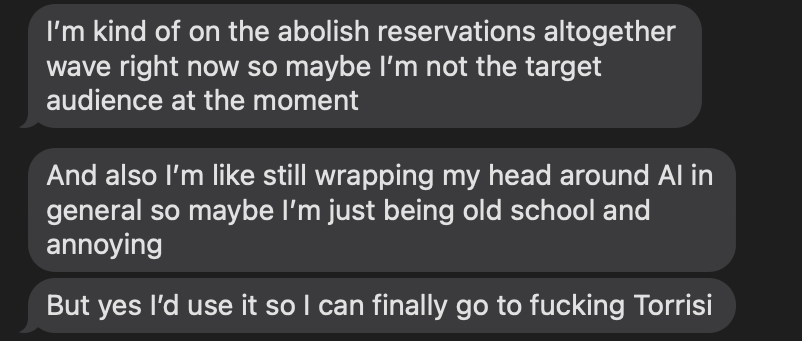
I don’t like always needing to go to the reservation apps.
I’d love to just manage all my shit from one place (something that’s also been great for me at work).
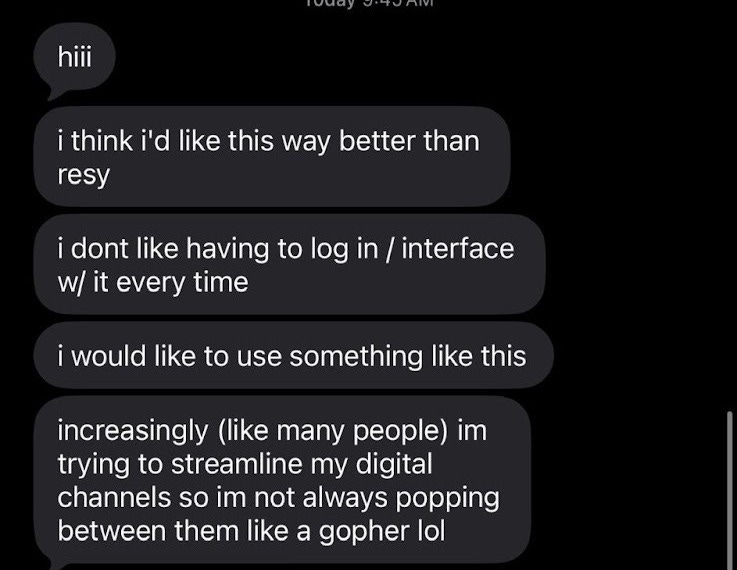
The Angel’s Emily Wilson sent me a particularly thoughtful email after I shared some Judd screenshots, writing in part:
I’m way more into this than I initially would’ve thought. But I’m also very bullish on AI when it comes to helping us use our time more wisely … I do think I’d use it because there is something appealing about just sending a text and having reservations handled through my reservation platforms, instead of dealing with those apps myself, which can be clunky.
I’m enticed by how it could help me in my goal of being better at being a regular, which is a practice I’m finally cementing this year. I’m into the idea that I could say hey, here’s a list of the restaurants I’m always down to eat at (and can keep adding to/subtracting from it as I see fit). Then when I have dinner plans to make with someone, and they’re letting me pick where, I could tell it to book at any of my regular spots.
During set up, my own personal concerns and fears included:
Is this incredibly lame?
Am I really going to text a bot named after my favorite artist like it’s a person?
How quickly will I turn into those finance bros I’ve met at parties who have an always-on Resy bot scanning for 4 Charles tables?
Will I do something very stupid that leaks all of my personal information?
Will Resy ban me?
Is this going to further remove the human touch from an increasingly sterile booking experience?
Olivia Weiss reflected on that last point well when I hit her up:
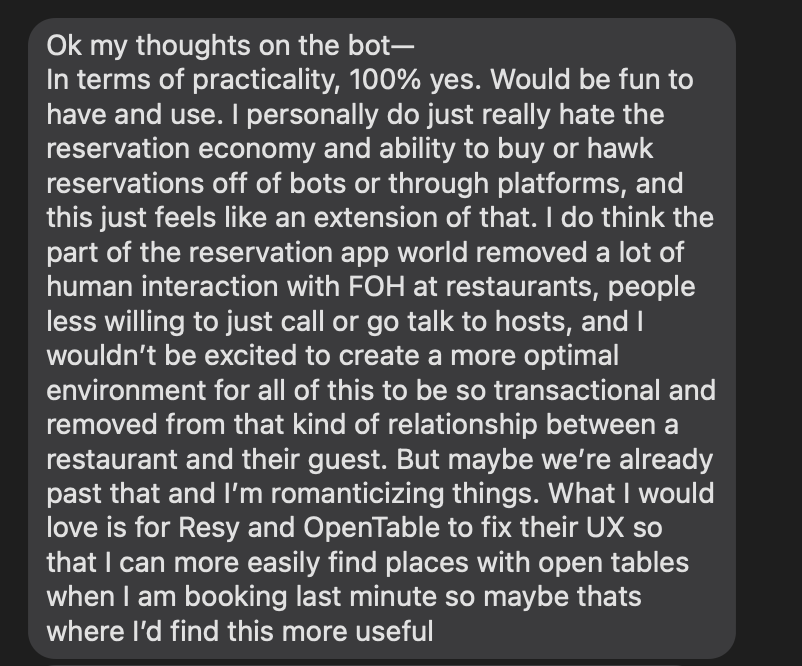
All technological advances bend toward making us less connected to each other. The ability to go on an app and book a table in a click inevitably makes you less connected to the people running that restaurant than having to call them first. It also makes calling feel so much more cumbersome. This shift overlapped with a moment in which where you eat became the most accessible way to display a certain kind of status. You can’t get into the most exclusive parties at New York Fashion Week, but if you refresh your phone right at noon and pray for a late table in 30 days, you can eat at Tatiana. That combination has warped how we approach where we eat and spend our money.
I’m not immune. A food-obsessed friend in LA asked me recently if I’d been to the new Babbo in New York. “Almost,” I said. “Then I saw that for an Italian restaurant in New York, it had, like, way too many available tables on Resy, and that triggered an instinctual red flag. If it’s this easy to eat here, is it good?” That’s a brain broken by reservation apps and the scarcity game they breed.
The other real thing about technological advances: You do still have some control over how you engage. I don’t ask Judd where I should eat. Plenty of people are in the process of building tools for that. Cool. They’re not for me. A bot can’t give you taste or happiness. Judd has a list of my favorite places, and it actually can’t book anywhere else. I could program more robust abilities, but I’ve found that these self-imposed constraints drive a more rewarding dining experience. I tell Judd the outcome I want and it searches my self-selected lists, letting me know what’s available. It’s built to drive that regularity Emily is seeking.
No version of a Resy or OpenTable UX redesign is ever going to make up for the ease of all of this being handled by a great AI model in iMessage. The next time I take a trip, I’ll still go through my ritual of asking a few well-traveled friends for recommendations. But I’ll also probably ask Codex to give Judd the ability to search those spots for openings.
I’m molding the system exactly to my liking. That’s easy when I’m in a small percentage of diners OpenClawing their way to a Friday night at Sqirl. I nudged up on my own bot-based limits the other day, setting up a twice-daily check for a few hard-to-snag birthday reservations. When everyone is prompting AI assistants to book their meals, are we just speeding up the race to the same four Torrisi bar seats?
Resy and OpenTable will try to ship their own versions of Judd. The same probably goes for Apple, Meta, Anthropic and OpenAI. The big question is what these products look like.
My favorite version is the simplest: Give me easy, centralized connections to all the stuff I care about, plus a powerful model that understands how I want to use each tool. Judd is already pretty close to doing that. The problem is that for any of this to really work at scale in dining, the booking platforms need to cede access to their walled gardens so that your single agent can operate across all of them. Not your dining agent or your SevenRooms agent, but the one agent you text about bulk Amazon orders and checking into flights. I’m skeptical that these apps or their credit card partners go in that direction quickly. And as it becomes easier for restaurateurs to vibe code cheaper, working alternatives to many of Resy’s features besides partnerships and marketing, that tension is only going to hit harder.
I’ll keep using Judd as long as my backdoored Resy hookup doesn’t get shut off. And whenever the connection breaks or I get banned — a potential outcome I’ve accepted — I’ll be fine. I’ll keep the same five restaurants in rotation, sending a text to the hosts or walking in. I’ll try the next OpenClaw competitor. Whatever easily and reliably gets me out on a Sunday night with a whole fish and a couple of pastas at Ètra, surrounded by my friends and the people who make that restaurant so special.
GIFs of real texts generated with Remotion and Claude Code. Some dates/times are changed. Want more from the edge of AI? Get ideas, apps and trainings over at Every.
As a huge Claude tool builder, and a fan of many of the La spots you reference, this rang true and was a great read!
Great use of an agent. Thanks for the inspiration