


My favorite restaurant takes happen in texts and emails. That’s where the smartest diners I know let it fly about what they’re gatekeeping, what food media lists make no sense and where the crowd is so insufferable they skip dessert.
As part of the Bangers & Jams 2025 year in review, we’re making those takes public. I got some of my favorite dining companions, cooks and writers to share their most memorable thing about the New York and LA food scenes this year — loves, hates, whatever they wanted.
There are recommendations to bookmark, of course. But I was struck by how many people are ending 2025 out on the other side — of the reservation battlefield, of the hot and trendy, of dining out as status symbol rather than point of connection. It’s a long one, but it’s juicy and worth it. Open it up in a browser and dive in.
I’m finding it unusually hard to think about the year in any sweeping way, mostly because it’s been one of real personal upheaval. So instead, here are a few dining-specific comforts I’m clinging to lately.
My old boss Ben Leventhal has a theory that every restaurant in the world is either a diner or a club, and for the reason I’ve already expressed, I’m only wanting the former. Places like B&H Dairy, Long Island Bar, and Anton’s — spots where I can set the tone and get exactly the experience I need that day. It’s grounding. I’m loving sipping on satisfying nonalcoholic beverages, because, sue me, I’m drinking less booze, whether that be the matcha-lima soda at Cafe 2001 or the flawless Arnold Palmer at Union Square Cafe. And I’m very into the creeping in of the British Invasion in food, from the opening of Wilde’s in Los Feliz to King duo Jess Shadbolt and Annie Shi’s soon-to-open Dean’s, plus the fact that sticky toffee pudding seems to be on every other menu. Mark my words: this will amplify in 2026.
Speaking of Annie, my favorite restaurant that opened in New York or LA in 2025 was Lei, which took me by surprise in its utter originality, cleverly exceptional food (by chef Patty Lee), cozy-chic atmosphere, and slay of a wine list. My favorite dish: Lee’s hand-rolled cat’s ear noodle with lamb braised in cumin and tomato. Lei signals how far the wine bar has come, that it’s no longer a trend we’re tired of, but a diverse, evolved restaurant category that’s here to stay. I’m all in.
I used to live a half a block away from Leo in Williamsburg, and when it came time to relocate — less than two miles away, but still — I was pretty distraught about the prospect of no longer having easy access to their perfect pizza (and perfect caesar, and perfect soft serve, and perfect wine list, etc.).
Early on into our move, my husband and I stumbled into 21 Greenpoint on a Wednesday and learned that every Wednesday, the restaurant makes pizza — and not just any pizza, but some of the best pizza I’ve had in the city. You can’t go wrong with their market pie, which is topped with whatever Homer picks up from the farmer’s market that day, but our usual order is the chevre/arugula/ mortadella pie and the Meg Ryan, a riff on the restaurant’s pasta dish of the same name. It has extremely pungent confit garlic on top, and the spicy tomato sauce is, blessedly, actually spicy. If you go with a group, you should get the nachos, too, which are legendary in their own right. The wine list is always fun, and while they don’t have homemade soft serve like Leo, you can (and should) end your meal with a sprinkle cone.
Over the last year, this has become a Wednesday routine for us, to the point where I often decline other dinner or event invites just so I can get my weekly pizza fix. I recently had a flight canceled that was supposed to get me back just in time for Pizza Wednesday, and I cried at the airport thinking about missing that confit garlic (and also my husband).
It’s the kind of experience I am genuinely tempted to gatekeep — I would be so sad if it went viral and I could no longer walk in and get a seat at the bar — but at the same time, the team is incredibly nice and talented, and they deserve the success.
Restaurants feel scrappy again, and I love it. Maybe scrappy is not the right word. I’m trying to describe some kind of grass roots movement of restaurants made by passionate people, built from the ground up serving some of New York’s best food out of little restaurants with tiny kitchens. Restaurants like Bong, Sunn’s, Chrissy’s, Ha’s Snack Bar, Los Burritos Juarez, have all graduated from pop ups to real life restaurants in the past year. It’s been so heartening to watch them become some of the most important restaurants in the city. The kids are alright. There’s still room to dream in this absurdly expensive city of ours. But please save me a reservation.
This year has been one of indulgence, of leaning into the sense of magic that comes from restaurants when all the facts aren’t predisposed, written out for you and shared digitally before you’ve even passed the threshold. The magic of the restaurant is back in its ability to create a sense of sleight of hand, some magic that creates nothing more than a curiosity to peek behind the curtain.
Katerine Morales | Cooking in Spanglish
When I was asked to contribute to this piece, I tried to write something positive about my experience in restaurants. But the truth is, 2025 was a tough year.
I grew up watching cooking shows back home in Ecuador. When the time came, I went to culinary school, worked in restaurants since I was sixteen and I never looked back. I love the chaos, the adrenaline rush that New York City kitchens offer. It’s always been a demanding job, but this past year, something shifted. The exhaustion wasn’t just physical anymore; it was emotional. I was tired of standing up not only for myself but for the Latino workers who felt they didn’t have the right to ask for something as basic as a break during their 10-12 hour shift. This reality wasn’t new, but in 2025’s political climate, everything felt heavier, more unfair, more targeted, more unsustainable.
It’s no secret that New York City restaurants depend on immigrants. With all the ICE raids, everyone was afraid to go to work. Seeing my team truly scared was devastating. How can you care about serving the most “Instagrammable” desserts when fifty percent of your team doesn’t even know if they will get back home that day?
But it wasn’t just seeing Latino workers experience the daily fear of deportation. It was the culture in general. You rarely see Latino managers in the industry, not because we are under-qualified. Despite having a reputation as the hardest-working people in restaurants, we’re overlooked for managerial roles far too often. I learned early on that if I wanted to be considered for leadership positions as a Latina woman, I needed to make myself visible, because how hard you work won’t always be recognized.
I spent 14 months at my last job, I quit when I realized they were all talk when it came to caring for their workers. I needed a break from this industry that everyone loves and fantasizes about, but that was simultaneously more politically upsetting than ever.
Still, I felt a wave of hope after the mayoral elections. NYC restaurant workers, who have felt so targeted and unfairly treated, now have a leader who recognizes their value. As Mayor-elect Zohran Mamdani said, “New York will remain a city of immigrants: a city built by immigrants, powered by immigrants, and [now] led by an immigrant.”
Let’s see where 2026 takes us.
This year I dined most frequently at the Chelsea Hotel, mostly the Cafe Chelsea, sometimes the Lobby Bar. It wasn’t a particularly prolific year in restaurants for me, at least on the American coasts, but the Chelsea has become a sort of safe space since it reopened a few years ago. Despite it becoming more of a spot for Lower East Siders recently, I can usually count on a crowd of rich clueless Europeans, horny out-of-town couples on dates and people with zero culture in their hearts and jobs that make a lot of money. I find this mix comforting and conducive to creativity.
I don’t think the food is particularly memorable, though I always get the Chelsea burger (a photo of it is my icon on WhatsApp), the steak frites or the beef tartare (the poor man’s bistro trifecta?), so there might be something extraordinary lurking on the menu that I’ve not tried. The Chelsea Hotel is, however, a good place to make memories, which is a characteristic I highly value in the places I choose to spend money or time. You can really channel the Chelsea’s bygone bohemian past when you’re drunk and swishing past the front desk and through the lobby between bars (lean into it why don’t you). As we prepare for the new year, I challenge you to find a restaurant that is good for your creative spirit!1
Gabrielle Scelzo | Perfect City
This year I decided I was done fighting my way into new restaurants. No 5pm or 10pm dinner reservations. No Resy Notify. No paying more than I would have on Dorsia. Absolutely no waiting in lines. So I went to restaurants where you don’t have to do any of that — old ones. Luger’s and Locanda Verde and King. I got lunch at Yura on Madison and drank wine at Stafili and ate steak frites at Orsay and grabbed chicken salad from Lassen & Hennigs. Even years, and decades, and in one case, a century later, they all still sparkle like new. Restaurants are better once their dining rooms are full of regulars. I did have a great meal at new Babbo, which is not really new, so I think that proves my point.
Brooks Reitz | A Small and Simple Thing
Superiority Burger is a perfect restaurant that doesn’t give a fuck about the way you think restaurants are supposed to act. Chef Brooks Headley (what a sexy first name) was a drummer in punk bands; that counterculture informs the creativity, the DIY sensibility, and the confidence that SB has in spades. I enjoyed SB several times when it occupied an East Village space barely larger than a telephone booth — you went, you ordered, you got the hell out of there. It felt fun, zany, and delicious, but the space clearly defined just how much wing spreading there would be.
When it re-opened in its larger space in 2023, I returned and fell in love all over again. Brooks feels like he has inherited the mantle that Gabrielle Hamilton left when she shuttered my beloved Prune. Like Gabrielle, Brooks is whipsmart, of a singular vision, and does not buy the bullshit most restaurant owners and chefs are sold about what you must do to run a viable, popular concern. He shops the market, sure. But he also serves his grilled cheese on Ezekiel bread. Sometimes store-bought is better — fuck your fancypants ways, poser.
There is an anti-consumerist, hippie vein that runs through his restaurant and I find it, quite frankly, exhilarating. The specials are scrawled on a piece of paper and taped to the wall, also adorned with stickers, illustrations on post-it notes, and random ephemera. It all might feel slapdash if the food wasn’t so good, so consistent.
In an era when operators are consumed with slickness — how will it look on Instagram?? — Superiority Burger has what might be the most poorly lit, put-it-on-a-plate-and-take-the-goddman-picture social media energy ever, and I AM HERE FOR IT. The real fans will know it doesn’t matter what it looks like, what matters is how it tastes. It’s always satisfying on a very primal level, despite some of the very fun swings his kitchen takes, and it’s a widely known fact that Brooks makes some of the best desserts in NYC.
Now that the restaurant is a couple of years old (a decade in NYC restaurant years), it has settled into a rhythm. The hypebeasts have moved on, and while it’s still busy, it feels like what it was clearly meant to be: a great neighborhood restaurant. Busy but accessible. And while I don’t live in the neighborhood, or in NYC for that matter, it’s one of the restaurants that remains on my constant rotation when I’m in town.
Kevin Arnovitz | Screenwriter
There’s a genre of Los Angeles restaurant that isn’t really about eating. You know the places: San Vicente Bungalows, the Tower Bar, the Soho Houses, an old-guard spot like the California Club. The menus read like cover letters — all affable proteins with logical accompaniments — and yet nothing on the plate warrants conversation. The food isn’t always bad. It’s just irrelevant.
I found myself in these places more this past year than I was inclined to be, because middle-age produces friendships with people who have zero patience for the jockeying required to snag a competitive reservation at a Restaurant of the Moment, and next to no interest in a jaunt to Alhambra for Bornean cuisine.
Several of my friends prefer the Bungalows or the Tower Bar as a default, not for celebrity-sighting or even exclusivity, but as a standing answer to where we should go.
There’s an easy explanation for some: Stickers dutifully affixed to phone cameras offer Jon Hamm and Jason Bateman the rare public space that functions like private quarters, where nobody’s angling for a selfie, dinner without the psychic overhead. But celeb sightings are pretty rare at these places, which are actually populated by media-class mandarins and upstarts, mingling across generations, not eating so much as occupying. They’re not there for a camera-free experience. They just like the room.
Maybe the appeal is that these places demand nothing. No reservation gymnastics, and no guided tour around the menu’s graduate-level compositions. The courtyard at the Bungalows is all bougainvillea and string lights, indoor-outdoor Los Angeles at its most inviting. The Tower Bar is a deco jewel box where Old Hollywood glamour hasn’t curdled into kitsch, which renders the joyless Caesar Salad and the $58 market fish (a most tragic piscicide) beside the point. The Soho House’s virtues? Maybe the comfort of being pre-vetted into a network of people who like what you like.
The last time I ate at the Bungalows I thought about Robert Altman’s The Player, and the industry lunches at The Ivy, studio execs and talent animating through spinach salads. The restaurant was never the point. The restaurant was the stage.
This is what the clubhouse restaurant offers: the comfort of being inside, the meal as backdrop to the room. Meanwhile, actual restaurants — the places where chefs are trying to create and where margins are impossible and survival unlikely — struggle to stay open. Since I prefer not to dine on forgettable, exorbitantly priced food at a club that would have me as a member, I’m always a guest, one who orders a burger.
2025 felt like the year the New York slice — specifically the artisan slice — evolved from Charmander to Charmeleon. It wasn’t just about new openings, but the density of them, especially in and around downtown. In late 2024, Chrissy’s opened in Greenpoint after operating a half space in the East Village and the hype around L’Industrie and Mama’s Too did not settle at all. It felt like a tectonic plate shifting underneath the city’s pizza map. Suddenly the Village wasn’t just a place where tourists grabbed Joe’s, but the epicenter of this new wave of sourdough driven slices.
What’s striking is how quickly gravity formed around the alums of these places. L’Industrie alumni are popping up everywhere — Andrea’s in the East Village, Slice Haus down the street from the Manhattan L’Industrie. Fermentation and ultra-hydration have become buzzwords in the local pizza scenes. Ceres, too, feels emblematic of the moment: a place that treats pizza like plated dishes. This all feels downstream of COVID, when people were stuck at home making breads. It’s rejuvenated new life into the city’s pizza scene.
But the flip side to the renaissance: the prices. As much as I love a slice that took 72 hours to ferment topped with some hot honey, I’m still stunned when a piece of pizza creeps up past $7 or $8 and a whole pie is more than $40. It’s made me appreciate the institutions a lot more. John’s of Bleecker feels increasingly vital and a reminder that excellence doesn’t need to announce itself with a premium. I love that getting a slice at Scarr’s doesn’t require standing in a 45-minute line anymore. The new Dumbo L&B Spumoni Garden makes the best Sicilian slice in the city more accessible to folks who don’t have a car. On the other end of the spectrum, seeing Di Fara essentially franchised onto Wonder — and the dip in quality when ordering from the ghost kitchen — was a real bummer.
I’m still choosing to be optimistic. New York is once again a place where the slice isn’t stagnant. It’s fun. It’s competitive. It’s evolving. And even with the price creep, I’ll take the wave of ambition over the complacency that defined the scene a few years ago. And yet, I still find myself yearning for a good New Haven slice every single week.
Maybe it’s that we spend so much of the day sealed inside our screens that by the time we get to a restaurant and slide our devices into bags and pockets, we’re forced to face each other. To bump knees, knock elbows, and catch ourselves in the mirror behind the bar. Even if we live or work among people, we procrastinate our feelings in the churn of scrolling and to-dos. There aren’t many spaces left that are safe from the internet. The table might be the last one.
Phoebe Ng | Hospitality brand strategist
My most memorable meals in NYC and LA this year were at places that had some age on them. New can be cool and fun — I professionally play a small role in facilitating their lore — but there’s something deeply fortifying about relinquishing yourself to a place that has truly lived. My husband was diagnosed with testicular cancer this summer. The days leading up to his surgery were unimaginable. Usually, restaurants are our escape. But the idea of going to a place that could still be in flux, when we too were standing on such unstable ground, felt wrong. So we chose to dine at places that have stood the test of time: Grand Central Oyster Bar (1913), ABC Kitchen (2010), Balthazar (1997). These tenured grounds offer different things to different people; regardless of the moment, they know who they are. In Los Angeles a couple weeks after Chase got the all-clear from his doctors, I sipped a lychee martini while watching Suzanne Tracht dressed in chef whites and aviator frames work the room at Jar (2001). It was fabulous.
2025 was — fortunately for my wallet and unfortunately for the vibe — my year of being “over restaurants.” Despite living between NY and LA, arguably two of the most coveted dining destinations, this year I became physically and spiritually over-saturated by the small plates and late-night etiquette of dining out. (I prefer to be in bed by 9pm). Pessimism aside, I did fall back in love with the small ritual of going to a restaurant for a “treat” (sweet or savory), or easy, cozy meal (typically more often ordered-in than out).
My favorites are as follows: Doubting Thomas passion fruit pie (Echo Park, LA), Amara Kitchen bison burrito (Highland Park, LA), Beverly Hills Juice Banana Manna Almond Shake add Apple Strawberry Coconut, add turmeric (Beverly Hills, LA). Bricolage chicken pho (Park Slope, NY), Maya Congee chicken ginger soup (Bed Stuy, NY), Myrtle Thai rice ginger soup, add chicken (Clinton Hill, NY … I’ve had a cold if you can’t tell), Roman’s chocolate sorbetto (Fort Greene, NY), Sailor’s french toast and thick-cut bacon (Fort Greene, NY). My one stand out, will leave the house for anytime, meal was at Cove (Tribeca, NY). They had an excellent selection of not-too-sweet N/A bevs (my pref) by Otis. What they’re doing is different and energized and always delicious with great portions in my opinion.
People are crying at restaurants. This year, I’ve seen a pad see ew go cold under a proper ugly cry at Night + Market in Venice. Mascara smear during a milestone date at Osteria Mozza on Melrose. Group tears fall over a mezze-loaded table at K’far in Williamsburg. I even saw damp eyes blinking hard amid the fish sauce frenzy at Ha’s on the LES.
When I told a friend I was writing about crying at restaurants, the phone went silent for a moment and then, “This is spooky. I just got home from crying at Gallagher’s.”
Crying in restaurants isn’t new. I’ve done it over the years, and maybe you have too. But this sheer volume feels new and profound. So does crying at a steakhouse bar in Midtown Manhattan.
Maybe it’s that we spend so much of the day sealed inside our screens that by the time we get to a restaurant and slide our devices into bags and pockets, we’re forced to face each other. To bump knees, knock elbows, and catch ourselves in the mirror behind the bar. Even if we live or work among people, we procrastinate our feelings in the churn of scrolling and to-dos. There aren’t many spaces left that are safe from the internet. The table might be the last one. And at the table, there’s nowhere to hide. Unless you’re one of those couples, you have no choice but to talk. Or even harder, you have to think!
So restaurants have become a default venue for real conversations. Breakups, breakthroughs, revelations, repairs, you name it. They’re sacred in a way we don’t discuss enough. Actual human hands cook the food. Actual butts sit in the seats. The whole system depends on physical presence, on strangers existing in close quarters. Maybe that physicality — the clatter of plates, the hum of people, the spicy soup — gives us permission to let it all hang out. I think it’s beautiful.
How can you care about serving the most “Instagrammable” desserts when fifty percent of your team doesn’t even know if they will get back home that day?
Lorenzo Bongiovanni | Mr. Flood's Party
I think we can all agree on one thing: 2025 was the year of lamb haneeth. Slow-roasted, bone-in lamb shoulder — a Yemeni speciality — is a delightful, nourishing dish under any circumstances. Many of my haneeth orders this year came from my enduring neighborhood locale, Yemen Cafe, which hits the spot every time. But in the depths of winter, I took the Q train to Bay Ridge, Brooklyn, to scope out an upgraded version of the dish I love so dearly. “The haneeth to end all haneeths,” some were saying.
I strolled into Yemenat for a late lunch on a Sunday afternoon with sky-high expectations. And somehow, they were not high enough. Yemenat’s lamb haneeth is special; roasted overnight in a tannour oven, the meat is impossibly tender, rich, and fatty, but with an unmistakable crust. It’s a textural marvel. The lamb is served over a plate of fluffy, aromatic Hadrami rice, along with a stack of freshly baked nigella seed-coated Rashoosh bread. Take a pinch of Rashoosh, a pile of lamb, and a liberal scoop of tomato-feta sauce, and you’ll be on your way to a transcendent bite.
I liked Yemenat’s haneeth so much that I rode a CitiBike 5.2 miles south down 5th Ave to eat it again this summer. It’s easy to get caught in the NYC hype cycles — extremely-limited-quantity burgers; another new French spot with beautiful sconces and an $78 half-chicken; a winding line to eat an indulgent-looking sandwich prepared by a Tik-Tok star, a movie-star, or a Tik-Tok star-turned movie star — but ultimately, my favorite dish (and favorite meal) this year came from a humble, yet impressively proficient Yemeni spot in Bay Ridge.
Kathryn Zahorak | the unmentionables.
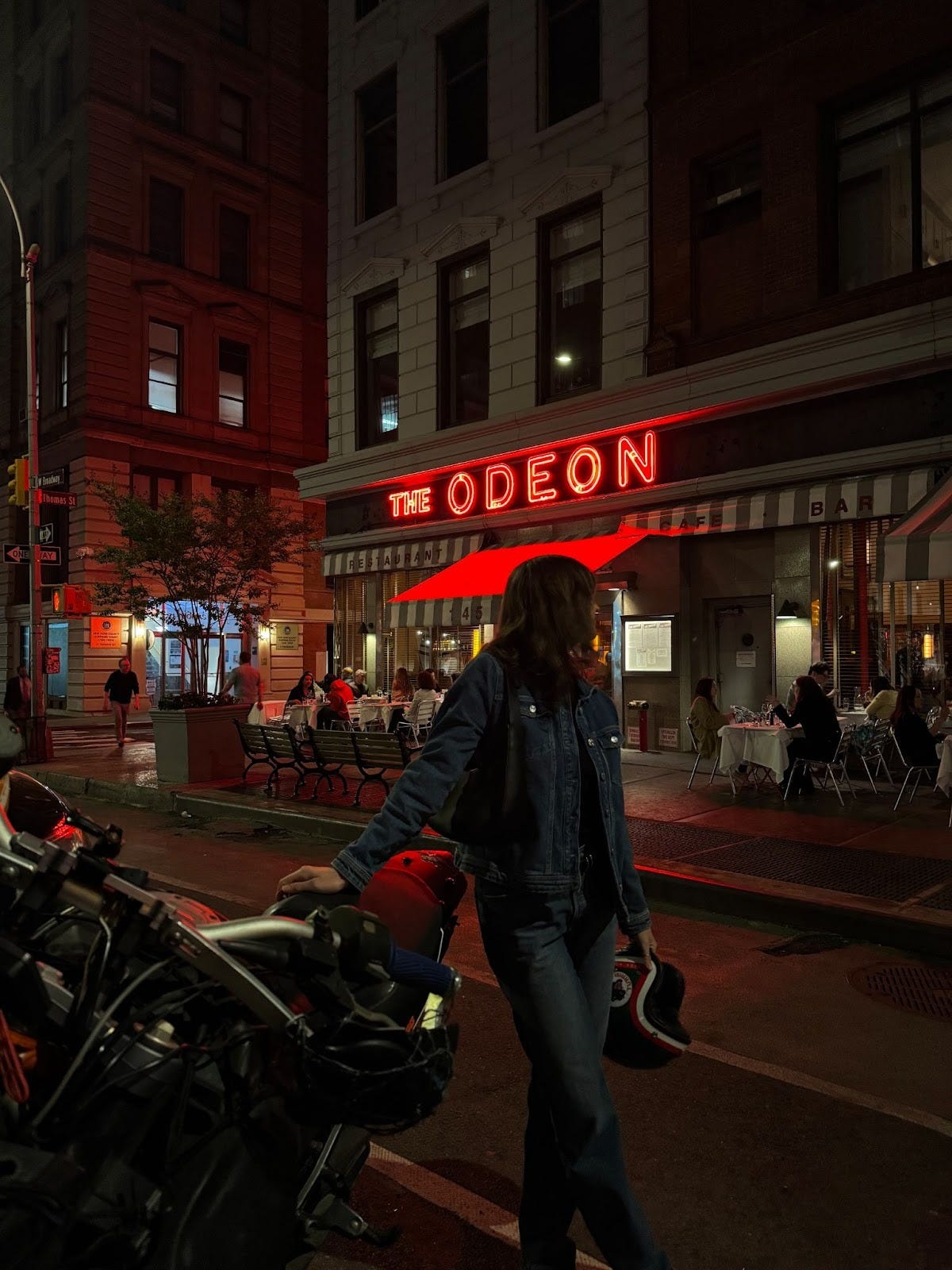
I believe everyone has one restaurant in New York City that is coated in nostalgia. An institution that almost serves as a beacon as to why they moved there in the first place. Please let me be a bit cliché. (I did just move back home to LA after a stereotypical three year stint in the city.) This place for me? The Odeon. Forever and always.
I was eighteen the first time I dined here. New to the east coast, a college classmate invited me to her Thanksgiving. We stayed with her fancy aunt in her fancy three-story Tribeca apartment and she took us to a fancy restaurant around the corner. I don’t remember what I ate. I do vaguely remember the servers gave us champagne without carding. But what lingered was the energy of the dining room. White clothed tables so close you’re brushing elbows and harmonizing conversations with the patron next to you. The crowd oscillating between “wanting to be seen but also, very much, not to be.” This felt like New York City. Red neon painted the street as we stepped back into the cold. All I knew, one day I will live here.
Fast forward over 10 years later, I unexpectedly found myself finally residing in NYC. As a single woman in her thirties, dining alone is one of my ultimate hobbies. I love sitting at the bar. I love wearing a cute outfit. I love writing in my journal with a drink next to me. (I don’t care about the potential of being perceived performative.) And The Odeon became one of my reliable spots. Dirty gin martini. Burger and fries. Maybe some flirting. Maybe a story from a neighborhood regular. The bartenders are always attentive and chatty, especially anytime I was solo. It is a classic for a reason! It’s OK to love places that everyone does!
This past April, the night before I moved out of my tiny studio, I requested dinner here. My Sicilian neighbor drove us on his motorcycle. Carmine down to Varick to Broadway. We decided on a table outside which I had never done before. It was an unseasonably warm evening. Dirty martini. Burger and fries. Typical people watching. And yapping with the servers. The red neon sign still persistently shining. And once again, I was struck with the feeling: This is New York City. We ended the meal with a giant fudge sundae. Got on the bike and drove back to the West Village. This was one of my most memorable meals of 2025 and the perfect toast to my departure.
Olivia Weiss | right on Franklin
The best part of New York dining is a sense of discovery we are constantly at risk of losing. This year’s highlights rested in the spots and experiences that made me need to get to the source. An off-menu glass of a Cuvee Weiss so good, I had to ask the waiter to bring the bottle back to the table so I could find it again later (2022 Dominik Held, FYI). A dessert spoon so perfectly round at Cove I take a picture of just my plate set up to remember them by. Espresso cups at Bridges that, with the link from their GM, now sit under my Breville. Butter so exceptional and plain at The Four Horsemen I have to ask my brother what brand they bring in (it’s Rodolphe, of course).
This year has been one of indulgence, of leaning into the sense of magic that comes from restaurants when all the facts aren’t predisposed, written out for you and shared digitally before you’ve even passed the threshold. The magic of the restaurant is back in its ability to create a sense of sleight of hand, some magic that creates nothing more than a curiosity to peek behind the curtain. Who did this wine list? Are these cups imported? Can I take the butter home? I want banchan with pickled vegetables I can’t discern and a bathroom candle I’ve never seen before. Mystery is so back.
The greatest neighbor I’ve ever had in my life finally opened up her first restaurant and it’s a complete breath of fresh air. Back in 2021, when I picked up the keys for my new spot in Echo Park, I was shocked to see a big day party in my neighbor’s garage. People were drinking wine, eating Venezuelan hot dogs, and everyone was raving about this Passionfruit lime pie. I was immediately introduced to my future neighbor Karla, who graciously handed me a hot dog and pie without even realizing we were going to be living next to each other. Since then, I’ve been fortunate enough to see the rise of Chainsaw first hand. I helped taste test recipes (even though my unqualified opinion liked everything), I helped store pies in my freezer, and got free invites to every single garage pop up she hosted. I got to meet a whole new community of chefs and artists through her events, and witnessed restaurants like Little Fish and Bridgetown Roti go from the garage to their own brick and mortar. There was something special not only about the food and desserts Karla was making, but also this bubbling ecosystem and cult-like following she grew organically. Some of my favorite meals of all time happened in the backyard and it’s hard to beat those memories.
But flash forward to today, where Chainsaw is finally out of the garage and experiencing a new version of itself built on the hard work, love, and passion that made those events so iconic. As Karla describes, the new spot is a hybrid cafe slash bakery slash restaurant serving a rotating menu of delicious savory foods. At the grand opening, I witnessed 200+ people crowd the block of Melrose Hill to celebrate the moment. It felt like a bigger version of the garage parties with people buying tickets to purchase empanadas, arepas, fried pork milanese, and a perfect tres leches cake. I couldn’t help but feel like it was a full circle moment from the day I first got my keys — except this wasn’t the end of an era but the start of a brand new one. The restaurant felt like a neighbor inviting you over to try what they’ve been cooking up, and if my personal experience was any indication, you’re going to love every second of it.
Maybe the appeal is that these places demand nothing. No reservation gymnastics, and no guided tour around the menu’s graduate-level compositions. The courtyard at the Bungalows is all bougainvillea and string lights, indoor-outdoor Los Angeles at its most inviting. The Tower Bar is a deco jewel box where Old Hollywood glamour hasn’t curdled into kitsch, which renders the joyless Caesar Salad and the $58 market fish (a most tragic piscicide) beside the point.
Yasmine Moazami | Reddit
Getting a reservation in New York City has become the culinary equivalent of getting into an Ivy League University — a high-stakes competition where only the most strategic and privileged survive.
Just like college admissions, there are three ways to hack the system. The first is the model applicant: you’re disciplined, you’ve done your research, and you know exactly when the reservations open up. You set your alarm for midnight, like it’s an early decision deadline, ready to click “reserve” the moment slots open up, only to learn the harsh truth that the slots don’t open up for those who followed the rules. Being a 4.0 GPA student doesn’t guarantee admission.
That’s where the second strategy comes in: gaming the system. Students hire SAT tutors and college guidance counselors to help them hack the system. People are deploying bots like they’re running a cybersecurity company to secure a 7:30 PM dinner reservation; there are even some companies that have monetized on the madness. Others rely on charm and connections; befriending a restaurant manager becomes the equivalent of having a legacy parent or an influential recommendation letter. Your goal is to get on the fake “text me anytime” list.
Then there’s the third path, reserved for the financially blessed (or those who like to accrue debt): buying your way in. Exclusive social clubs promise premier dining partnerships the way admission teams guarantee college spots. Pay the membership and suddenly you never have to see the words “no reservations available” ever again. It’s the fundraising wing of the admission office, just repacked for elite foodies.
These restaurants have stopped serving meals and have begun serving taste. Everything is a bite, a moment, and a pretend shared experience. We’re paying $40 for a shrimp cocktail to only receive a shrimp per person, which we must delicately split and parcel out like we’re negotiating the peace treaty. We leave $200 poorer, and with growling stomachs — unless you’re on Ozempic, which, in this case, congratulations, the system was designed for you.
The truth is, we’re tired. Just like students who simply want to learn without performing for admission committees, New Yorkers just want to eat. We want to sit with our friends, have nice conversations over satisfying food, without needing the Rick Singer of reservations to help feed our children and us.
We’re going back to the basics. We’re throwing in our napkins. We’re saying goodbye to the game of reservation hunger games. Bring back meals, dinners where everyone orders their own food, just like you would if you were in Italy.
If I’m spending hours securing a reservation like I’m applying to Harvard, then feed me like a champion if you’re going to charge me like one.
Too many people are too reliant on rating aggregation systems (think Yelp, Rotten Tomatoes, etc.) and for subjective things like food and art that is just dumb as hell.2
I’m going to try to go through this quickly:
Everyone is just different. There are so many people whose opinions I trust with great taste with preferences and standards extremely different than mine (and with each other). Which is why averaging their opinions of how good something is on a 1-to-5 or 1-to-10 ranking is just insane to me. Not to mention, what “3.5” means to everyone is just different!
Even the best restaurants are just extremely inconsistent, not even the food or service, but just how the diner experiences the meal. Who else is in the room? What did they have for lunch? How did they sleep the night before? All of these things play a real part in how a person feels about their 90 minutes in a restaurant! And so, again, how are you somehow averaging all of these completely random numbers together and saying that anything can be gleaned from that? Don’t even get me started on ratings that also ignore seasonality and are just … all time???
I have a very rudimentary knowledge of data sciences, but I do know that the working premise is that the more data you have, the signals will eventually outweigh the noise, but I just think that’s way less relevant when it comes to art/subjective and personal experiences. Plus, if the internet has taught us anything, people en masse just have shit taste. You know what the most popular TV shows in (both in the US and THE WORLD) were in 2010? CSI, Big Bang Theory, and Two and a Half Men.
Which really drives home the other main point, a point that goes against everything that the internet has unfortunately led us to believe: there is no such thing as the best restaurant.
Even if a Substack writer tries to come up with an elaborate, multi-faceted scoring system that ends up with Cervo’s (a very good restaurant!) being the best restaurant in New York or LA, it’s just not going to be true to everyone!
There are thousands of pieces of content being made every day, every second, to tell you that “this hidden gem is the best whatever you’ve ever had”, and while it may be that for some people, there’s a ton of folks for whom that’s not true at all — and that is all ok! It’s totally ok for things to be just good or great! Many things are! Life is beautiful! (Roberto Begnini voice).
And, really, the main reason I bring this up is because I think all of this is just a real net negative for restaurants (and art).
I think it’s bad(/sad) when a perfectly good restaurant is hyped up to be “THE BEST” (by ratings, by the internet, by whatever) and it doesn’t live up to those extremely unrealistic — and probably impossible(!) — expectations, resulting in a disappointing experience for the diner. Let things be good/great! Or even just your favorite!
So, yeah, go everywhere! Try things! Listen to your friends (or Substackers you trust), and just keep an open mind and enjoy the many good and great restaurants!
P.S. The Chelsea does operate under a dijonnaise policy that I find unacceptable. I do not want to dunk my fries into a mixture of dijon mustard and mayo, like some sort of featherless burger sauce!! They should listen to me and change to a delicious homemade mayo ... rich with a little tang. That is what a frite needs. It could be so simple!
Both in determining quality, trying to find a quantitative consensus, or even just figuring out what you as an individual might like.
hell of a bicoastal squad you assembled here
The restaurant games! Could not agree more. Who has a recommendation for a festive, vibey, fine dining-not stuffy restaurant for celebrating my twins 24th birthday in NYC - friday, jan 9th??? Tried for the Polo Bar (and many others) - no luck. Any recommendation from you fvery knowing experts would be very much appreciated. Thank you and Happy New Year to all!