



There’s something charming about a restaurant that only ever serves the same, single dessert. Typically this is pastry done by a savory chef, one low-lift but flavor-juiced hack for a small kitchen team looking to satisfy the sugar-crazed. You’ll often find herbs, salt, and olive oil. Plating during service is minimal if nonexistent. If you’re a regular, you might order such a dish three visits in a row, skip it for six months, and then have it nestle in your brain one day and demand a return.
At Drifters Wife in Portland, Maine, that was the malabi, a Middle Eastern milk pudding that eats like panna cotta without the gelatin. Chef Ben Jackson would occasionally change up the set with the seasons. At its best you’d get a cup topped with the freshest Maine blueberries and thyme. It was never the highlight of the meal. But it carried its own kind of history, hugging you through previous scoops in this same space.
I got a craving for that malabi dish in October, sitting over on Washington Street in Portland’s East End. It was one of the last impossibly bright Maine days before the cold starts to take over. Drifters Wife had been closed for five years. It only ever existed because owners Orenda and Peter Hale needed food around as a vehicle to get locals to try their natural wine selections at Maine & Loire, a wine shop they opened in 2015 after leaving behind Brooklyn restaurant life. Both turned into sensations during that wild, pre-pandemic, every food publication in America is obsessed with Maine boom.
But the restaurant half of the business couldn’t survive a COVID shutdown. Now Maine & Loire occupies the entire space, primarily as a place to purchase bottles, though you have the option to sit, drink and hang, like I was doing. Peter poured me a perfect, bright glass of sparkling while I finished Among Friends by Hal Ebbott. Echo & the Bunnymen’s Porcupine played front to back. Peter said business was good — tough, of course, anything in this industry is tough, but this setup works for their margins and their family’s day-to-day.
The ghost of Drifters Wife haunted my reading of this New York Times piece on the new Gilded Age of menus, outlining how restaurants are devising dishes featuring $600 suckling pigs, Wagyu flights and caviar bumps with martinis. In specific cities such as New York, Dallas, Aspen, Las Vegas and Miami, these opulent platters cater to the 1% looking to flex, the brands with big budgets and the influencers looking to post their way into another class stratosphere.
In many ways, this is just good business. You don’t get rich off selling 18 malabis a night, no matter how charming those little cups are. The owners of Drifters Wife also would not have been able to move many $1,000 bottles of wine or caviar flights with their clientele of Maine diners. I don’t think the tables could even hold a two-pound lobster dish.
Drifters Wife was a restaurant for dinner. It was a small, scrappy darling, pulsing life and memories into each visit. It had soul. It’s my favorite kind of thing. Carbone Riviera and Santi are something else — something closer to luxury real estate and curtained-off clubs, flinging uneaten platters into the trash while calling the night a success.
Can these two extremes co-exist?
Pillion is one of the best movies of the year. Harry Lighton’s directorial debut had its relatively small budget financed by production companies in the UK and Ireland, some of which receive funding from the government to promote the arts. It’s a funny, honest and raw portrait of a gay sub/dom relationship between characters played by Harry Melling and Alexander Skarsgård. It has the most powerful makeout scene I’ve witnessed in years.
A recurring motif throughout the movie is Melling’s character cooking meals for Skarsgård’s as an act of submissive utility. He stands and watches Skarsgård eat, since the other seat is occupied by a dog. At one point, Melling asks to get one day off per week from their dom/sub dynamic to do normal couple activities, like go get breakfast together.
I’d imagine Melling’s character had somewhere like Wilde’s in mind. This new Los Feliz restaurant is a dream. A place to linger with a book and the California sunlight splashing through the windows onto your sausage roll during the daytime, and a place to fire nearly the full menu of British-inspired dishes on a roomy four-top moving onto its second bottle of wine during the evening. The bangers & mash, fish & chips and pork chop were three of my favorite dishes this year.
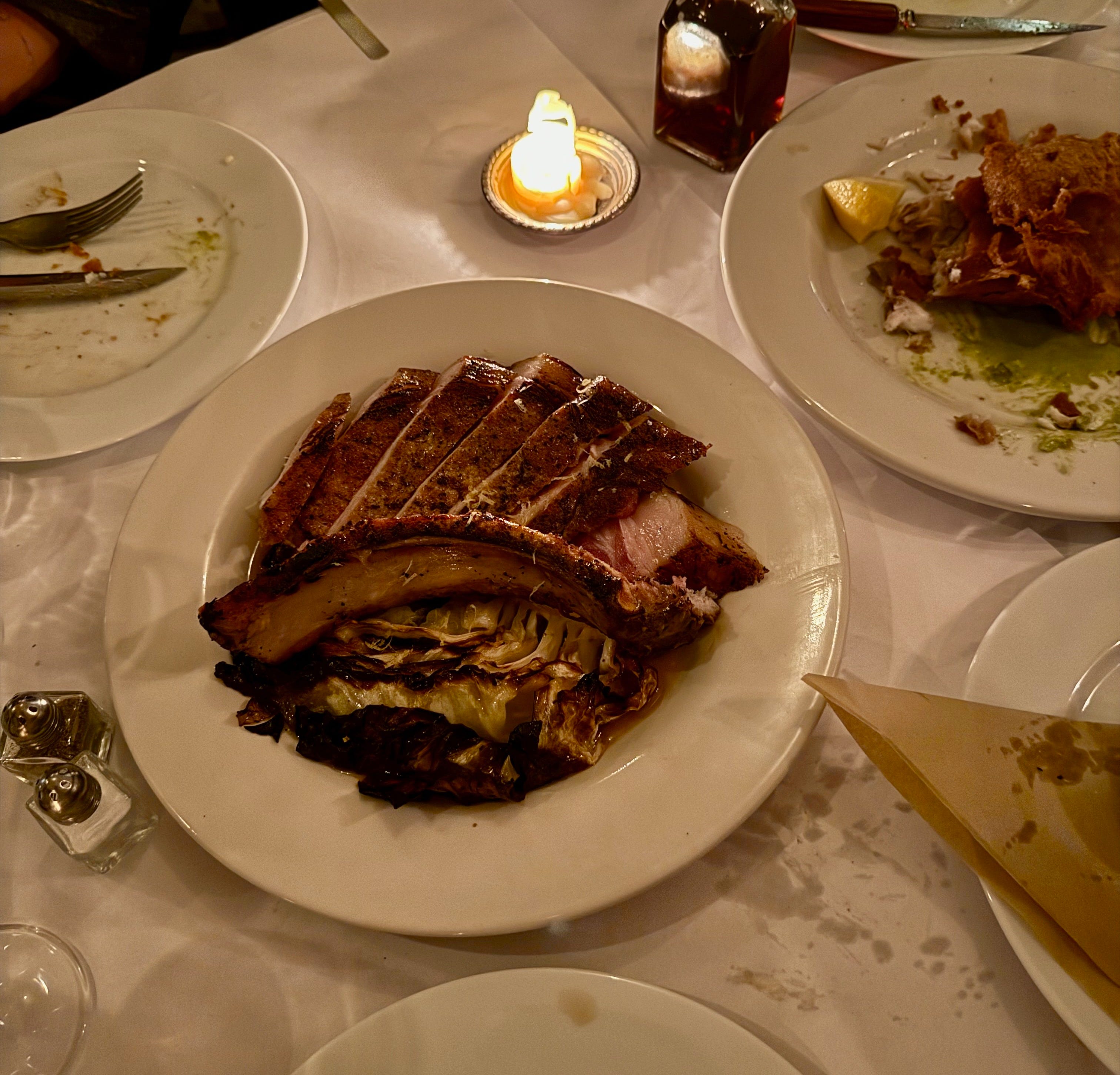
Co-owners Tatiana Ettensberger and Natasha Price imagined the space as a neighborhood spot, one that locals could easily pop into for a full meal at one of its 30 seats or just a quick bite and a drink. It’s proven much too popular to really allow for that, with lines forming well ahead of its 5:30 opening. By doing all the right things — like carefully building a beautiful space in the right location at the right time, firing knockout dishes with consistency, and handling every little fire that pops up with grace — Wilde’s has entered that echelon of restaurant where a flood of diners not only want to eat but want to be seen eating.
You might look at this demand and think: Shouldn’t Wilde’s follow the Carbone model down this gilded age trend? The other day, a building issue forced the team to close for one dinner and one breakfast service. You could feel the gut punch in the tone of the Instagram announcement — this stuff really matters when you’re building something small and special. It’s not going to sink them, but every moment counts in restaurants like this.
So if there’s demand in such an affluent LA neighborhood, why not add a $400 whole fish set? Why not roll out a regular Sunday roast in exclusive partnership with Dorsia with four-figure tickets?
Well, lots of reasons. Mostly, these two worlds don’t blend well. You can’t have 20 diners popping into their local for rarebit and sticky toffee pudding while the other 10 stack seafood towers to the ceiling. You lose your spirit without capturing the real financial upside.
Teams behind movies like Pillion always call them small miracles. Just like with Wilde’s and Drifters Wife, it takes a tremendous amount of work and one hundred lucky breaks to make the thing at all and then get people to spend money on it. Pillion is being distributed in the US in February by A24, the indie studio with growing ambitions. This week, A24 is putting Marty Supreme into wide release, throwing one of its biggest budget bets behind star Timothée Chalamet and director Josh Safdie.
Marty Supreme is weird, fucked up, incredible. It’s how a bigger budget should be used, taking a stellar cast and breaking them open into a chaotic jaunt across New York and the globe in the 1950s. The only real meals in the movie happen inside of international Ritz-Carltons or similar high-ceilinged spaces built around luxurious statements. You don’t catch anyone eating. Following a big win, Chalamet’s character Marty orders the two most expensive things on the menu, simply because they have the highest price tag. He’s giddy and proud, an outsider in this room desperate to be its epicenter. He commands waiters, picks up another table’s bill, shares loud stories and talks past his tablemate. He passes off the tab to the table tennis association, leading to a fine that threatens to derail his career.
Very few people will ever have access to these kinds of rooms, and Marty knows that. It’s why he’s so determined to get in and stay in. He’s not alone. Right now, there are thousands of hopefuls with Resy notifies on for The Corner Store, 4 Charles and Torrisi. They want to ball like the 1%, while the real 1% would never need Resy to get the table.
A small portion of these gilded-age restaurants are actually quite good. Torrisi is one of them. It’s a big-budget blockbuster that delivers on its promise of dry-aged duck ($56) and cavatelli with Jamaican beef ragu ($32) for the people who are there for dinner, and $500 Snake River steak sets for the affluent looking to stunt.
I’d love to see the Wilde’s version of Torrisi. A boisterous second concept providing a rare reason to get dressed up in LA. The Hollywood system is broken and showing few signs of improving, but I see filmmakers graduating from small productions like Pillion or Good Time to bigger-budget swings like Marty Supreme as a reasonable food world comp. Maybe there’s a way to get both the precious neighborhood gem and then the Amex Platinum destination from this new wave of great chefs and restaurateurs.
Because there are only going to be more gilded age menus coming, just like there are going to be more big franchise IP plays in theaters. Occasionally a regular diner will snag a 5:15 res at one of these spots. When they arrive they’ll realize that, yes, money and access makes a lot of things better. But it doesn’t inherently make your meal more delicious.